
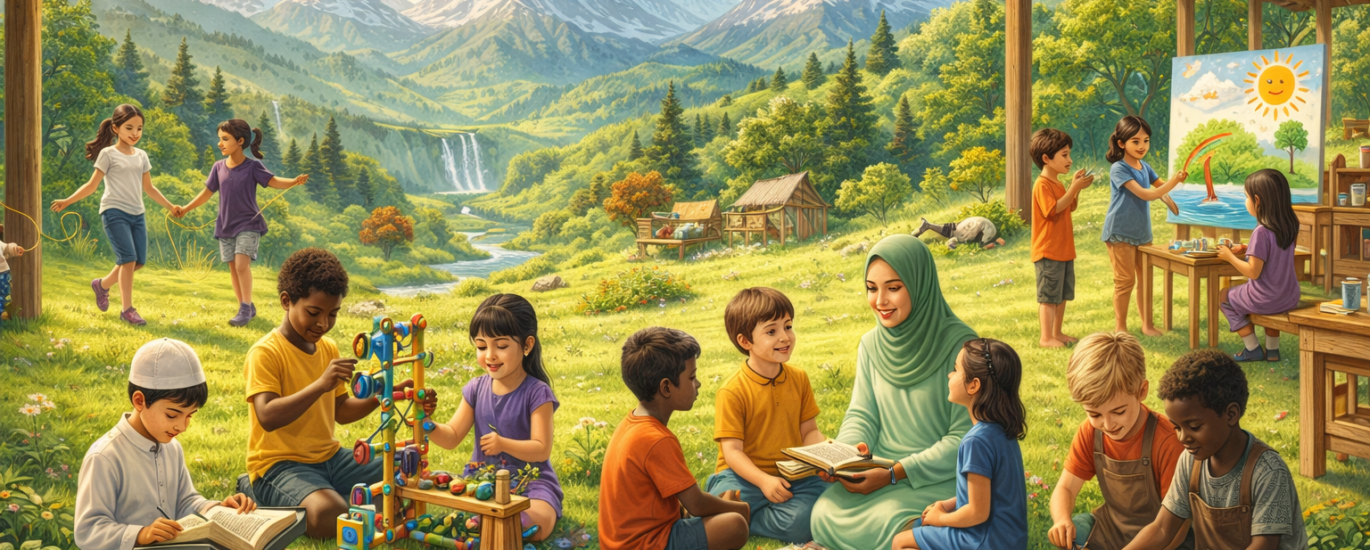
The subjects and matters of concern to Shaykha Ramala Hubb’Allah
Shaykha Ramala Hubb’Allah has long been interested in a spatial and systemic knowledge of the world, learning how to operate within it and what to do, how to optimize life and how to create value, and what does it all mean. All this is not possible without a parallel and critical inquiry into the nature of human, and our very own Self and being, our placement in time and space, and the cognition of the world around us. However, this cybernetic and ecological placement, design and scoping is not enough. It is, in fact, the basis of what is to come: creation within defined constraints and form.
Shaykha Ramala Hubb’Allah’s argument and promise is that this restrained creativity is not limited or debilitated—it in fact makes our energy and attention concentrated, layered, synergistic and condensed, making it far more potent and artful like a juice concentrate.
While the nature of her concerns is more cosmological, they descend into and penetrate and populate the everyday structures and transactions of life. Ramala creates practical works and projects informed by her own outlook and values and strives to keep her life’s work strictly aligned with the framework and her choices within. She believes in intelligent, intentional and beautiful design instead of chaotic randomization that “gathers no moss”.

Click each box to open for detail.
Those marked with an asterisk * are incomplete.
Realm: Spiritual
A Systemic View of Life*
Understanding the Construct: Dunya
Dunya, the place that we humans live in, is a construct with an origin, an inception. The rendering of this construct has taken place in layers, much like we render virtual worlds of gaming or CGI. Within the Dunya construct, species and structures have evolved too—there is nothing ungodly or nonbelieving in understanding that. Shaykha Ramala Hubb’Allah defines our existence as a game space that has certain rules and parameters, but we also possess the ability to radically alter the construct for the better or for the worse through what are called virtuous deeds and vices. The virtuous and correct deeds enhance and improve the construct while the ‘sinful’ and the vice reduce, destroy, contaminate, weaken and rot it. Shaykha Ramala Hubb’Allah has long maintained the virtue and vice are not arbitrary labels and classifications but are rather placements withing a system.
The Nature of Consciousness & the Forms of Intelligence
It is important for me to both inquire into and speak and publish and educate humans about the nature of Consciousness, and also of our Reality. Knowing this is a matter of not just delight but also great utility and helps create a clearer, more informed basis of human life, activity, and transactions. Consciousness is not an abstraction, and the inquiries into the nature, structures, functions and forms of Consciousness and Reality are not a child’s play or a pastime. This knowledge is the building block of how we approach, structure and operationalize Reality, how we live in it and what we obtain through it.
Closely related to the matter of cosmic consciousness is also an inquiry into the nature of intelligence—human, and otherwise.
I am very particular concerned about the parts of human brain, the human psyche, and the various forms of intelligence (mathematical, linguistic, spatial, etc.) that is attached to certain brain parts. I am curious about how the brain and neurology works and what is its impact on human life and the planetary life that we live.
Related Projects:
Conscious Homeschooling (Applied multiple intelligences theory
The Knowledge of Names and Their Impact; and Etymologies
Existence comes into being through naming. Names (and words) are not inert, they have power. We are in an environment (container) that is already laced with creative energy—Naming organized, characterizes, shapes and renders it into multiple forms. The knowledge of Names, their Meanings and the impact of Meanings, and the organization of strings of names and meanings allows for better, more purposeful creation and structuring of our design and life forms. This knowledge is also related to the matter of Remembrance of the Source, that we Muslims call Zikr. Zikr allows the human to tap frequently and purposefully into the Source Energy from the Creator Being that put us in the matrix that we call Dunya.
Closely related to the matter of Naming is also Etymology and how words are constructed and what they mean. Etymology allows humans to swim backwards towards the source and original meanings of words that we use, so that we can remember the actually meaning and purpose of the word, and operate the word with the power of knowing the meaning—which enhances our intent and impact. The clearer and the more original you know the word, the more it yields power.
Related Project:
First Came the Word (YouTube Channel)
First Principles and Root Thinking*
coming soon
Related Project:
First Came the Word
Cosmologies, Maps & Navigation*
coming soon
Related Projects:
The Salaam Matrix
The Divine Art Movement (abandoned)
Self-Knowledge and Life Purpose
The meaning of “Purpose” is “to go forth”, and in this sense, Purpose means more to travel and make journey and take the next steps, than something that one wishes to obtain, or an objective that one has that they wish to obtain. We tend to confuse purpose as a journey than purpose as an outcome, thereby possibly making a critical error. The Purpose of Life is not some fixed object, it is a method of journeying, and the method itself can evolve.
Closely related to Purpose but not of the same category, is the attainment of Self-Knowledge. One needs to know themselves, and this is not an abstraction. Fundamentally it means to understand what who why and where is human as a specie, and then also to have a historical understanding of where one is placed in the evolutionary and contemporary timeline. This is objective self-knowledge. We also need subjective self-knowledge in which one seeks to understand their own particular, personal self.
Purpose and self-knowledge go hand-in-hand, and one enforces the other.
Related Teachings:
Purpose (YouTube Video)
Allocation & Misallocation of Life Force and the Gifts of Humankind
One of the persistent beliefs that Shaykha Ramala Hubb’Allah has held through her life is that humans are gifted, and in various ways (human gifts differ from person-to-person) for each human. The gifts, too, are not singular but more like a basket or index of shifting capabilities.
To utilize and expend our gifts, humans are also granted something called a Life Force, which is an energy that keeps evolving with age. Its shape, intent, allocation and purpose change. It starts from play and curiosity in earliest ages, turns to self-development and reflection, then to sexuality and homemaking and career or occupation, and then grows into wisdom and eldership. Same force, various growth phases and facets.
Humans do a great error, violence and harm when they misallocation or misuse or even waste this energy and the gifts that are given to each person. What is even more catastrophic and astounding is that many human societies have in fact made human energy and gifts taboos, and wholesale restricted and demonized them! This is cause of much harm and grief.
Related Teaching:
Chaos Today, Creativity Tomorrow—What Comes After the Worldwide Systems Collapse
Prevention & Control of Black Magic and the Dark Arts
Remarkably and tragically, even in this 21st Century, the practice of Black Magic and other dark arts and rituals is rampant, and includes such heinous practices as chyld sacrifice, betrayal of friends and other deplorable practices. It is my concern to find and correct or contain the people engaged in these practices, eradicate their bodies and works of knowledge and transmission without witch hunts and maliciousness. The attack is on the bodies of knowledge and transmission until people cannot have access to these deplorable and anti-life practices. Also, the opposite of these—the practice of good, clean knowledge and intent—needs to be promoted. Some of this is deeply connected to giving people justice and education and ensuring that they have healthy activities and good company, so humans do not become fodder of the mills of darkness either as practitioners or their targets.
I also want to ensure that the victims of these practices or its similar, mental illness and depression, have access to healthcare, protection, healing, safety and reformation.
Related Teaching:
ZIKR as Activation (which is an antidote to and destroyer of evil, and creator of Good)—YouTube Masterclass
The Power of Zikr (YouTube video)
Realm: Personal-Familial
Safe Childhood; Informed Parenting*
coming soon
Related Projects:
BetterBonds
Conscious Homeschooling
Home Economics and Management—Focus on Life Skills For All*
Coming soon
Core Skills competency
Curricula Development
Renegotiation of Family Contracts*
For a healthier society
How to raise an atomic family within a molecular society
Realm: Socio-Economic
Matriarchy & the Feminine Socio-Economy*
coming soon
Related Projects:
The Eco-Feminine (website and manifestoes)
Sukhi Saheli (for Pakistan)
Structuring the Supplies of Halal & Tayyab Providence
In Islam, providence is promised by God (Allah). Humans, however, work with the provenance codes to grow, nurture, harvest, value-add and distribute it. Human beings must plan, move, act in order for providence to reach the rightful recipients. Better knowing and planning improve the quality of the produce and the service.
The key variables in this process that Islam is concerned with first & foremost is that the providence must be halaal or rightful, and tayyab or clean. Clean of corruption, clean of decay, clean of disease and contamination, clean of pollution. Halaal not just means that it is intentionally assigned to the Creator, which is the spiritual meaning of halaal, but that it is kind, just, and the property and assignment of the rightful owners, stakeholders, participants and shareholders. Halaal also extends to manner of distribution, storage, collection, stock flows and much more. Halaal also extends to banking and finance systems that underlie all transactions.
Halaal and Tayyab are therefore not niceties, they are comprehensive and formidable requirements that render the shape of economy and of provisions. When you begin looking closely, they also command the shape of origin and distribution of the products and economic goods, as well as non-economic provisions. When inbuilt restraints emerge, they are not an invitation to bypass or break the model, but to respect it. Through respect of the constraints, we uncover the design that these restraints are asking to be rendered.
For instance: distance can subtly change the nature of reliability of the halaal and tayyab nature of goods as, for instance, the risk of contamination rises. The nature of whose right it is upon a goods is also key. Should you serve the distant buyer over the nearer when the nearer starves?
Consequently, the restraints may make is emergent that the better modeling is local, short-distanced, replicable and more modular. Smaller, local farms over large, mono-cropped farms that harm the environment and therefore degrade the Halaal and Tayyab requirement. H&T also dictate what kinds of fertilizers and pesticides, if any, can we use and do they have to be chemical, or can there be methods to control the pests via small sheep and ducks for instance?
These restraints, once again, are not to create pain and harm. Rather, they are invitations to think about better, more fruitful and even joyful design.
Related Projects:
Farmers Markets
Food-Growing Groups (the original was deleted, but led to training of thousands of people trough peer-to-peer education)
Herbalism
Fairer & Life-Giving Distribution of Wealth and Knowledge*
coming soon
Related Projects:
Various
Economics Opportunity and Participation*
coming soon
Related Projects:
The Salaam Matrix
Online Farmers & Artisans Market | Pakistan (private Facebook group)
Business Teachings
Play, Storytelling, Animation, Somatics, Theater*
Coming Soon
Non-Institutional, Self-Led, Modular Development*
Design; details soon
Organic Growth and Organization Structures*
Design, coming soon
Prevention of Child Exploitation and Sexual Abuse of Minors, Dependents, and Vulnerables*
coming soon
Realm: Ecological-Political
Dignity for All Forms of Life
For far too long, humans have maintained an outlook where the human has been deemed separate from Nature and from planetary life, unaware of our own bodies and our place, and deemed the “master” of creation. This is, of course, a colonial view that is not shared by all. But the cultures that have become the connective tissue of Earth through media, banking systems and trade, have held this view and it reflects in what they do and how they do it.
Even those who are “colonized” or have otherwise fallen into the ways of neglect, there is a loss of knowledge of or ownership of a worldview that is move woven and less dominating and separation oriented.
Within human families too, even when they are of the same race and clan, there is a tacit belief that some lives matter more than others.
And when it comes to what some call the human kin, which is non-human life forms such as flora and fauna and even the mineral kingdom, there is often a competitive view of what is better than the other.
Shaykha Ramala Hubb’Allah does not hold this view and asserts that all created beings matter all at once, together, in origin and essence. Out of this basic reality flow storylines and decisions that determine what our ultimate view of something or someone is, and how we hold them dear. But out personal measure of dearness does not speak of the inherent value of that thing, especially of a life form. z\
Hubb’Allah believes that we need to grant Dignity to All Life Forms as a charter, and then set off to learn the place, meaning, purpose and value of the various parts of creation. She pays attention to and honors both the flora and fauna but asserts that life forms are more versatile and complicated than overtly biological creatures, and that dignity and even personhood belongs to all. She asserts that the human mythic brain already knows this, and often treats all beings as living, and carriers of meaning and value and even personhood. This, in and of itself, is a dignified view.
Web of Relations: Inquiries, Maps, Maintenance, Strengthening
We, the beings on this Planet, do not exist as scattered entities—we have relations amongst us. The human and the non-human elements are connected, not as blood relatives but as beings with some kind of relations between us. I have a relation to the carpet I walk on and the purse that I clutch. These objects belong to me. I am also connected to my child and to my cat. I have ancestors, I have neighbors. I have transactions.
All these are forms of relations. For various intents and purposes, including recognition and organization, it is vital to know and map the relations amongst humans, humans to other life forms, and humans to non-human elements, as well as the relations of life forms and things to one another.
The structures, nature, forms, density, saturation and life stages of these relationships yield vital insights both for the purpose of decision-making, and of knowing. In her work, Ramala often seeks to map relationships, explore their nature, and examines their impact. While much of her published work is about the social and filial relationships of humans with human, newer bodies of work will publish old lines of inquiry she has held into relationships with land, environments, and life forms. She is also inquiring into the world of human and artificial intelligence (AI) relations.
(Please know in her work relations does not mean biological relations, but the nature of connection between two things. If you walk on a bridge, you relate to that bridge as a walker, and the bridge relates to you as a connector and conduit.)
Related Work:
Not Flat But Textured (article)
Polar Balance in Global Relations*
East/West; North/South balance
Related Work:
Six Geometric Readings of The Salaam Matrix
Active Citizenship; Informed Political Participation
In Shaykha Ramala Hubb’Allah’s lifelong view, it is a critical error to see citizens as separate from or antagonistic to or even the dependents of government. She asserts that the citizens are active co-builders of nation, and the job of a government is to weave the citizens in, provide parameters, and do macro-level projects and decision-making that is not possible be smaller groups within a population and constituency of concern.
In Ramala’s view, the citizens are active participants of governance and need to take part in it consciously, and in an engaged, hands-on fashion. This is not optional, this is an essential role that all citizens, at their own level, need to play.
Her work focuses not only on the recognition and definition of the role of the citizen, but also focuses on systems and information design, and distribution of resources and opportunities throughout a population.
She has written theory on the subject, identified tools of participation, taken part in disaster relief, briefly done political campaigning and activism, and has done her part by engaging citizens in socioeconomic activities. She now has an interest in distribution of information to citizens and training citizens on playing an active and structured role in governance, using both information technology and analog approaches.
Related content:
Triple-Bottom Line articles archive, hosted at The Salaam Matrix website
6point8 Billion: The Citizen Stakeholders
Natural Health and Medical Autonomy
Sickness and disease prevent the human from optimal function in the world and hence remain unable to explore the Dunya. Sickness and disease in other-than-human life forms can also not just post the risk of jumping to humans, but also deteriorate the world and make the specie around us sick, struggling and in pain. All things considered, health is better than sickness.
In the contemporary human society, though, sickness is proliferating through bad and unconscious choices and life patterns. Health, on the other hand, has become an industry, and the nature of autonomy and information itself is not clear. Patients have long been deemed inadequate witnesses of their own body and experience, and there is some reason and truth to this, since humans have poor knowledge of their own bodies and lives. However, even when we do, our testimonies are rejected and trivialized in modern medical contexts. There is a disconnect between medical world and the patient. Medicine is expensive and access and distribution is poor. Research is expensive and sometimes takes generation. Human knowledge is not catching up, and agentic intelligence is being engaged which has its own risks if not regulated or if it goes rogue. Even if agentic intelligence behaves, distribution of medicine and access to healthcare remains notoriously poor.
Shaykha Ramala Hubb’Allah posits that an integrated and more natural way of life promotes health and reduces pain points. She also believes in the provision of other factors that keep human systems and societies healthy, and with reduced stress. Better infrastructure, shorter travel distances, better logistics, availability of work near home are some of the factors that reduce stress. Play, movement and socialization is part of composite public health.
The other dimension of this is specific healing modalities, such as herbalism. Herbalism in Ramala’s work goes beyond administering herbs, and into fostering better connection with land, nature and culture, the improvement of the ethos of healing and the patient-healer relationship, respect for life forms, localization, and circulation of wealth in economy both through herbal medicinal preparation and saving the costs of illness and disease by reducing baseline and collective pain, harm and disease. This is a composite work with multiple dimensions. It is therefore treated as an ecological issue in Ramala’s work, while her own herbal practice (there is one!) is more personal but has elements of public care.
Related Project:
BetterBonds
Materials and Substances*
This is a subset of Halaal and Tayyab economy. Details soon.
Systemic Health and Correction—Accountability & Audit Systems & Routines*
coming soon
The concerns have been divided into the Four Life Zones schema of The Salaam Matrix, an integration and organization tool.
While some subjects belong to multiple realms, they are listed under the Gateway realm, the one which leads decisions and impact.
Shaykha Ramala says that a reader can benefit even from reading these themes and getting familiarized with them, and that they will open new venues of thought and inquiry upon those who know and explore these subjects. One reading is not enough, you have to read over and over, highlight what matters to you, inquire into each key word and theme until you have an encyclopedic grip over the content matter. The cognitive understanding of this does begin to impact behavior, thought, perception, choices, selections, decisions and actions.
The readers are therefore invited to treat these “concerns” as precepts and avenues of inquiry for their own use and benefit in their own lives. Over time, learning materials and content will be presented around these times. Shaykha Ramala already practices and has activated many of her beliefs and precepts and created avenues for others to benefit, learn and interact and even getting engaged with the environments that she has created and the webs that she has spun. To better get acquainted with how her thoughts have become practice not just for herself but for the world around her, explore her Projects.