

Watermelons. They have become the symbol of Resistance of the People against the Vampire Empire. The origin of the motif is from the sacred lands of Palestine. The motif has spread like a melon vine through social media and in protest marches.
While developing a banner for my business “The Salaam Matrix” to declare our support for the People vs the Empire (Learn more in our Social Responsibility Statement), and to support the people of GAZA who are experiencing a genocide, it occurred to me that we need to ‘melonize’ our businesses and economy—which is not just token support and allyship with the cause, though those are vital first steps, but also, wide-spread, deep, real, rooted changes to the way we do business. The business of economy, and the business of Life.
What does it mean to ‘Melonize’ the Economy?
It means that we start auditing the economy for justice, fairness, and correctness at the point of purchase, using our power to spend our money on the better business, and therefore begin shifting economy atomically, decision-by-decision. It all starts with asking the question:
What is the end game of the current economic streams that I, my family, my community and my business are engaged in?
And then asking subsidiary questions such as:
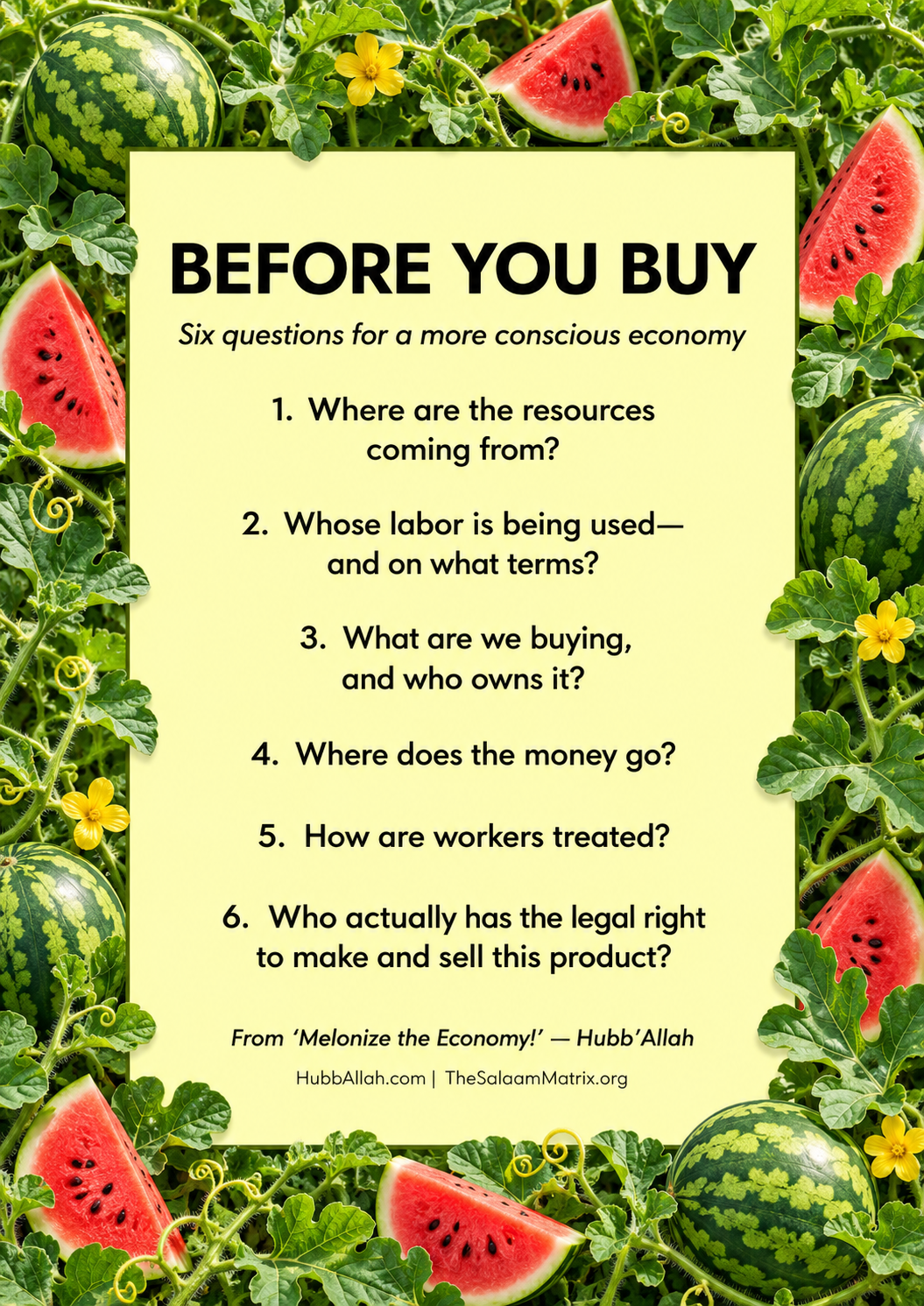
~Where are our resources coming from?
~Whose labor are we utilizing and on what terms?
~What are we buying and who holds the ownership?
~How do they spend the money, and how do they treat their employees?
~What is the source manufacturer of the product that I am using? Do they have legal and legitimate rights to produce the product and content that they are producing?
BONUS: DOWNLOAD THESE QUESTIONS AS A CARD—
Click image (PNG) to open and save:
How to ‘Melonize’ the Economy effectively? Do we ‘cancel’ businesses? (╭ರ_•́)
No, we don’t just cancel. We also create.
More of.
More of what we want.
More of what aligns!
“Melonization” is not merely a withdrawal of support; it is the deliberate cultivation of better markets. My appeal, therefore, is that we make Melonization a process, not a penalty.
This creates a growing and increasingly attractive incentive for makers, creators, suppliers, sellers and businesses to move toward better, fairer, more transparent, just and service-focused business. We make the idea compelling, not compulsory through unpleasantness.
This means that markets are seen as cooperative where buyers help train the market through conversation and by signaling their shifting choices. From the buyer’s end, this happens through declaring choices through social media, interest groups, and even cooperatives. While the buyers can choose their values in their heart and mind, it is vital that the businesses know what those values are, and to care for them. This is naturally more likely to happen, and to happen faster, when buyers and sellers share values (and are perhaps from the same groups in population). Sometimes, there is a distance.
On the seller’s end, listening through social media, forums, articles and directly interacting with the customers and understanding their priorities, as well as reading research, is what is helpful. The seller would need to examine their own biases and filters to make better decisions.
Finally, third spaces where both parties converse and engage ideas, and agree to work together to make incremental but certain change, are important to establish Dialog, study and data analysis spaces and tools are important. The idea is to work together to implement the values, instead of customers becoming hostile and punitive, especially where the seller side is emerging, nascent, vulnerable or struggling.
Because bringing goods to market is subject to several factors and conditions outside the seller’s control, sellers cannot always or immediately be perfect. Therefore, the market overall has to shift towards implementation of shared socioeconomic values. And this is what is meant by “process, not penalty”. That does not rule out penalties which apply and are due at times and must be honored, given that the overall intent is to cooperatively develop markets for the good of all, rather than the customers assuming the old divisive behavior of being victims/punishers of markets. That framing needs to retire.
This is vital if we want to make the movement inclusive and not create chain reactions of cancellations and penalization and wizard wars with curses flying off left and right! THIS is what behooves a new collective marked by collaboration and cooperation. Essentially, we are transforming only-boycott logic into also market-shaping, future-crafting logic—and this is where our future lies, sustainably, melon-ically. 🍉
From Boycotts to Shaping Better Markets: A Short Manifesto
We cultivate alternatives.
We communicate values.
We increase attractive incentives.
We create feedback loops.
We cooperate where possible.
We build better markets.
This input is a review by AI and is incorporated as part of Hubb’Allah’s MINDS Initiative. MINDS brings human & not-human intelligence together to explore creative and problem-solving possibilities and to undertake frontier work in convergent intelligence working for planetary benefit.
For further insights into ‘Melonization’, stay connected with Hubb’Allah; also, explore sister project, The Salaam Matrix.
Article updated on: October 15, 2026
Image: Mark Stebnicki